
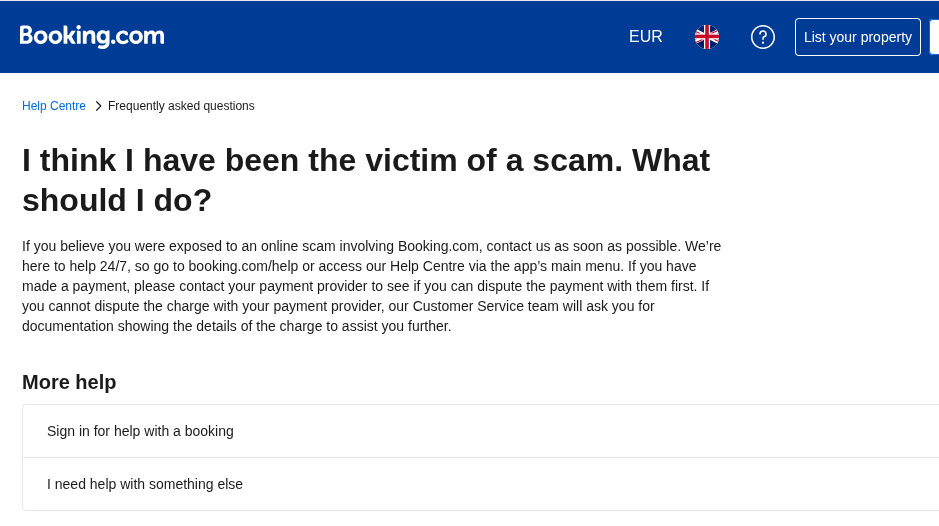
Online travel booking service Booking.com is in trouble. After asking twice (September 2025 and May 2026) for reports on how the company is managing rapidly increasing scams on its platform, the European Commission finally opened an official investigation in October 2026 for a potential breach of the EU Digital Services Act (DSA). Scams that targeted travelers, hotels and other accommodation providers increased 500% according to Booking.com’s own data.
The EU investigation will focus on three key problems in Booking.com’s operations.
- Fake listings. There is a vast amount of sad stories on the internet about travelers who have booked an accommodation only to find a non existent address or a house without lodging services in the destination. A recent example of such was a listing on Booking.com that offered Downing Street 10 for tourists in London. If the address sounds familiar, it is the British Prime Minister’s home.
- Scams that allow criminals pose as Booking.com. Scammers have discovered a way to access and exploit real data from Booking.com online service by logging into the system as an accommodation provider. The scam has frequently been reported for years, but Booking.com hasn’t been able to prevent criminals from exploiting the system.
- Paid listings that are not identified as ads. Accommodation providers can boost the visibility of their listings on the platform by paying an additional fee. These paid ads are not always identified as such.
So what is wrong with Booking.com? Why the online service with multimillion user base and revenue hasn’t been able to fix the problems that have been known for many years? A reason could be that the victim usually is a traveler. He or she pays the bill for the fraud. Artificial intelligence (AI) is also enabling new types of system breaches and fraud schemes, but a corporation like Booking.com with vast resources should be able to defend its computer systems and data better than it is doing now.
What can a traveler do to avoid Booking.com scams?
For an ordinary traveler, fake listings of non existent accommodations are difficult to detect, as well as criminals posing as Booking.com who might be asking you to re-verify your credit card. Nonetheless, here is a simple method for staying clear of Booking.com (or Airbnb) scams: separate your accommodation search and reservation transaction into two isolated actions.
- Do your accommodation research in a search engine, in Booking.com (if you like), or on another booking service you prefer. Once you have discovered the places that fulfill your search criteria, move to the action point 2.
- Make direct contact with your chosen hotels or other accommodation providers. Find the web page or phone number of the destination, and book your stay directly with the place you want to stay in.
It really is as simple as that. Both hotels and private hosts usually are happy when you book directly with them because they save the extra cost that an online platform will charge them. You may benefit from, for instance, special weekend packages and hotel chain loyalty programs when you deal directly with them.