
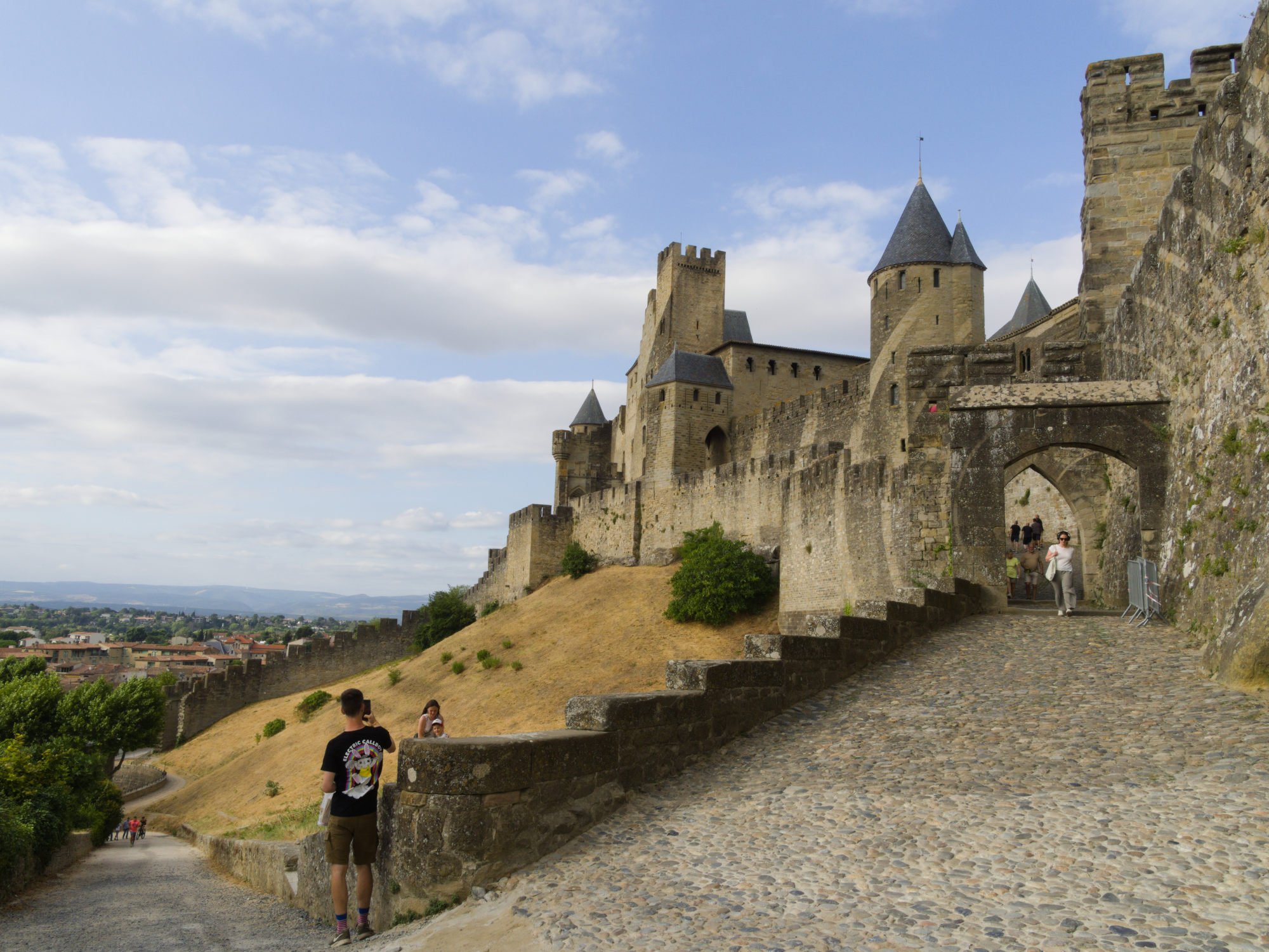
In the southern France, not far from the Mediterranean Sea nor from the Pyrenees mountain range, the walled town of Carcassonne continues to amaze visitors as it has done for two thousand years. The fortified walls protect medieval houses, a Gothic church and an ancient castle that all can be visited. Restaurants and shops along alleys have their open hours, but gates to the town are always open.
The medieval and partly even older town is inhabited, although tourism has turned many small houses into restaurants or shops. Residents, but no one else, can drive along narrow alleys to their houses. In winter, life is peaceful as residents go about their daily tasks, but during summer months, you only see other tourists, or perhaps people who are queuing to a concert. When I visited Carcassonne the last time in July, heavy rock fans had formed a queue around the church in the evening. They were not waiting for the church to open, but the concert stage next to it to kick into action.

The impressive outer and inner walls with 52 towers are the main attractions of Carcassonne, but the charming town inside the walls is where the local life, restaurants, bars, galleries and shops, as well as the Gothic Cathedral and the Comtal Castle await visitors. Guided tours are available as well.
You can walk all the way around the town between the inner and outer walls. There are multiple gates that allow entering into the town through the inner wall, but only three gates to exit the fortress through the outer wall. The total length of the wall is three kilometers.

If you visit Carcassonne during a popular vacation time, you have to enjoy the experience with thousands of other tourists. Narrow alleys and small restaurants inside the town walls tend to be packed. Since the town gates are always open, an early morning or late evening tour should give you more space to explore and admire historical houses.
The city of Toulouse is a major traffic hub in southern France with an international airport, and with good railway and highway connections. Carcassonne is about 100 km east from Toulouse along the A61 highway or along railway. If you drive to Carcassonne, the walled town is signposted with Cité signs along major roads. Large car parks are located on the east side of the walled town. Campervan drivers may choose to stay a night at one of the parking areas. Parking tickets must be bought from a ticket machine at each car park.
Unesco listed Carcassonne as a World Heritage site in 1997: “In its present form, it is an outstanding example of a fortified medieval city with an enormous defensive system developed mainly in the 13th century. This system consists of two enclosures separated by barriers surrounding the houses, the streets and the superb Gothic cathedral, as well as the castle and the main buildings associated with it.”

Brief history of Carcassonne
An organized settlement was established on the hill in the 6th century BCE, but it was the Romans who built the first wall around the hilltop, making Carcassonne a fortified town in the 2nd century BCE. Visigoths modified the walls in the 5th and 6th centuries.
In 1096, the Trencavel family started the construction of Basilique Saint-Nazare that was turned into a Gothic Cathedral in the 13th century.
During the 12th century, a religion known as Catharism had converted many people in southern France in the region around Carcassonne. Catholic church regarded Catharism as a threat, and the Pope initiated the Albigensian Crusade to wipe out Cathars in 1209. Carcassonne, among other fortified towns inhabited by Cathars in the region were attacked until 1229.
The walled town had become a strategic military site at the frontier between France and the Kingdom of Aragon (today, Aragon is a state in Spain). The outer wall was built in the 13th century.
The Treaty of Pyrenees in 1659 changed the role of Carcassonne, and the town was abandoned. Almost 200 years later when demolishing of the fortifications was planned, local people managed to convince the government that the walls and the town should be restored as a historical monument. In 1853 the renowned architect Eugene Viollet-de-Duc started the long project to restore the historic site.
